
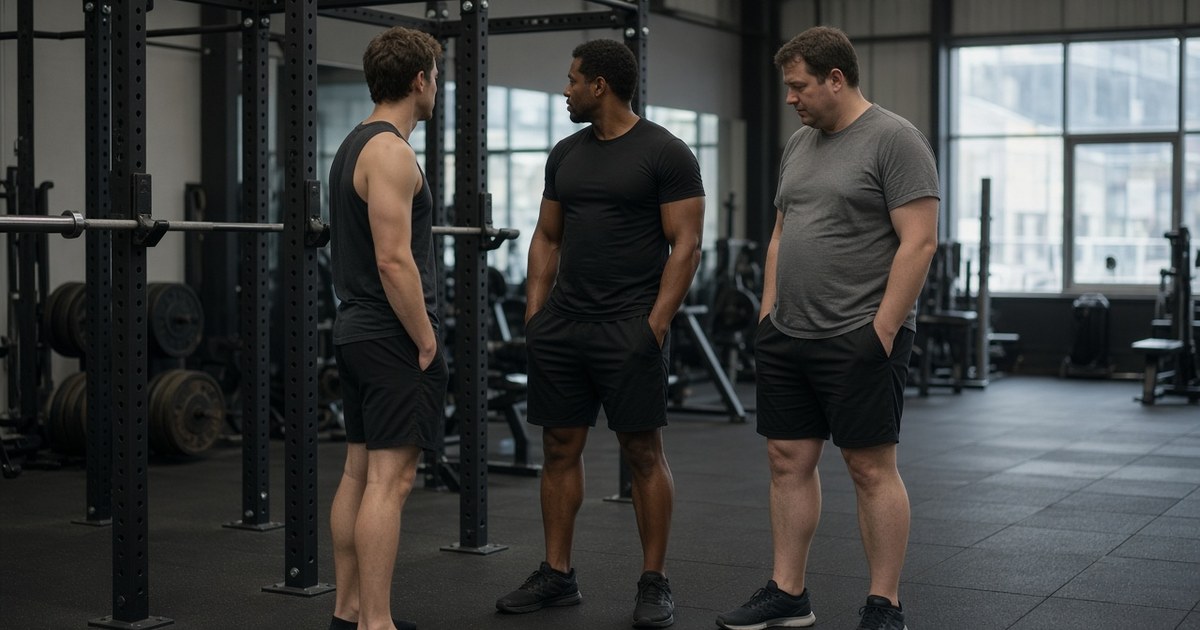
"I am just an endomorph, fat loss does not work for me." "I am an ectomorph, I will never build muscle." I have heard it a hundred times. It sounds like a scientific explanation, and it often becomes a reason to stop trying. It is a myth. Your body type describes how you look right now, and you can change that.
Not as fixed genetic types. A psychologist, William Sheldon, invented the split in the 1940s so he could guess personality from body shape, and today that theory is treated as nonsense. A body-type label only describes your current body composition, mainly the ratio of muscle to fat, and that can change.
Where the three "types" came from
This theory did not start in a gym or in a nutrition lab. An American psychologist, William Sheldon, came up with it in the 1940s, and it was not about training at all. Sheldon claimed he could read a person's personality from the shape of their body. A thin ectomorph was supposed to be shy and nervous, a muscular mesomorph assertive and dominant, a rounder endomorph easygoing and sociable.
The personality part sounds like a horoscope today, and science treats it that way. What survived is only the descriptive part: sports scientists still use somatotype ratings (the Heath-Carter method) to describe a body as it looks now. Sheldon's "constitutional psychology" has long been considered nonsense. Some of his measurements came from photos of naked students, and the personality claims did not hold up. Fitness marketing, a few decades later, pulled out the three nice-sounding boxes and turned them into "body types" it could sell you a special diet and a special program for.
What those "types" actually describe
Look at it soberly and there is nothing magical in the words. They only describe your current body composition and shape, mainly the ratio of muscle to fat:
| Label | What it actually describes (right now) |
|---|---|
| Ectomorph | Little muscle and little fat, often a tall, narrow frame. Usually little strength training and an intake that does not support muscle gain. |
| Mesomorph | More muscle, low fat, "athletic." Years of training and decent food showing up on the person. |
| Endomorph | More fat, with muscle hidden under it. The result of a past energy surplus, often with little movement and little strength work. |
Notice one thing. None of those descriptions includes the word "forever." It is a snapshot from today, and you can take another one.
Why it is not genetics, and not fate
Yes, genes play a role. They affect your height, shoulder width, bone length, where you store fat, and how fast you build muscle. That is true, and nobody is denying it. But how much muscle and fat you carry is not a fixed category. For most people, it is largely the result of what they eat and how they move over time. If you have a thyroid condition, PCOS, or take medication that affects appetite or weight, talk to your doctor before you change your plan.
Body recomposition shows it best: gaining muscle and losing fat at the same time. When an "endomorph" starts lifting, eats enough protein, and watches calories, their body composition changes, and over time they can move toward the "mesomorph" look they assumed they were not born to be. And an "ectomorph" who swore they could never grow, grows, once they eat enough and push the weights. Their genes stayed the same. What they ate and how they trained changed.
I see it in clients all the time. People who spent years saying "I just have this kind of body" look completely different after a year of work. What changed is that they stopped treating the label as a final verdict.
Why the label mostly hurts you
The bigger problem with the boxes is what they do to your head: they quietly take away the sense that you can change anything. The moment you say "I am an endomorph," you are quietly saying "this is not on me, this is my body." And if it is not on you, you also cannot do anything about it. So why try?
That is a self-fulfilling prophecy. The label calms you down, and at the same time it takes the most important thing: the sense that this is in your hands. And it is.
What to do in practice (the same for every "type")
You do not need a secret diet for your "type." The levers are the same for everyone. Only the starting point and the speed differ:
- Calories for the goal. Want fat down? A mild deficit. Want muscle? A mild surplus, and patience. That holds for a lean person and a rounder one.
- Enough protein, about 1.6 to 2.2 g per kg (about 0.7 to 1.0 g per lb). It holds muscle in a diet and helps you build it in a surplus.
- Strength training as the base. That is the tool that actually changes the "type." Without it you only become a lighter or heavier version of the same shape.
- Steps and ordinary movement. A cheap lever on expenditure that is easy to overlook.
- Consistency over time. A body does not change in a week. It changes over months of small work you can keep doing.
Where there is a grain of truth
To be fair: people really do differ. In the skeleton, in height, in where they store fat, in insulin sensitivity, in appetite, and in how willingly they build muscle. That is real. Those differences sit on a sliding scale, and there are far more than three of them. And they do not mean you should train and eat in a fundamentally different way. They only mean someone starts further along, and someone moves faster. The goal and the tools are the same for everyone.
So the next time you hear "I am just an endomorph," translate it in your head to "this is how I look now, because this is how I have lived so far." The second part can change, and that is where the work starts. Be Effective!
Frequently asked questions
Can I lose fat and look athletic if I am an endomorph?
Yes. Lift, eat enough protein, and manage your calories, and your body composition will change. How far you get in a year depends on your starting point, but the direction is in your hands.
Do I need a special diet for my body type?
No. The levers are the same for everyone: calories for the goal, about 1.6 to 2.2 g of protein per kg (about 0.7 to 1.0 g per lb), strength training as the base, steps, and consistency over time. Only the starting point and the speed differ.
Do genes play a role in building a physique?
Yes. They affect height, shoulder width, bone length, where fat is stored, and how fast you build muscle. Those differences sit on a sliding scale, and there are far more than three of them. They do not mean you should eat and train in a completely different way.
Why is it harmful to tell yourself "I am an endomorph"?
The label quietly shifts the story to: this is not on me, this is my body. It is a self-fulfilling prophecy that takes away the sense that this is in your hands.
Related reading
- Build Muscle in a Calorie Deficit: Yes, It Can Work
- Macros and Fat Loss: Track Two, Not Four
- 5 Objections to the Calorie Deficit, Answered
Want me to coach you?
Gold coaching in English, fully written. A weekly report from your phone (3 minutes), my written answer with your plan, WhatsApp support Monday to Friday, calories and macros adjusted every week, a plan for eating out and travel. No video calls needed.
Apply for coaching Get the free Fat Loss Kit Calculate your calories
Martin Barna
Online nutrition and fitness coach. Since 2013 I have coached 600+ clients, with an evidence-based approach to fat loss.
Apply for coachingThis article is for information only. It is not medical advice. If you have a health condition, talk to your doctor.