
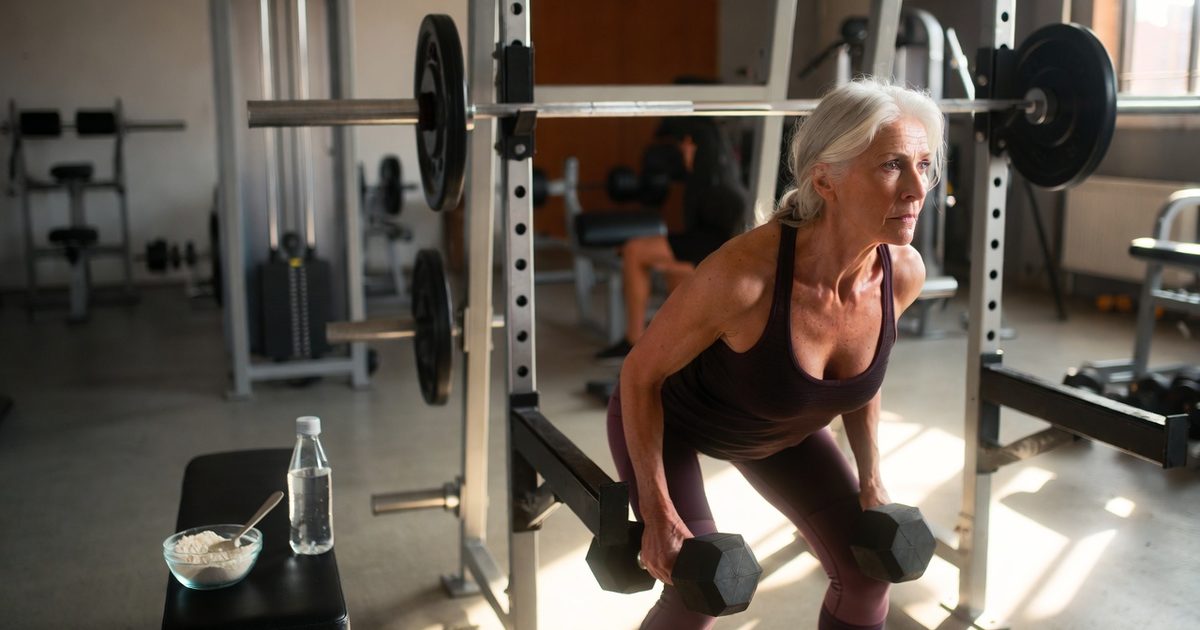
Creatine still carries a label in a lot of heads: "a supplement for jacked guys." That is a waste. It is one of the best-studied supplements we have, with a strong safety record, and women have plenty of reasons to use it too. Reviews from 2025 and 2026 point to benefits beyond muscle: strength and body composition, and possibly mood and brain health as we age.
Yes, especially if you lift. A 2025 review finds that creatine supports strength, performance, and body composition in women, mostly together with strength training. Take 3 to 5 g of creatine monohydrate every day, including rest days, on top of the basics (protein, lifting, sleep, consistency). If you are pregnant or breastfeeding, have kidney disease or another health condition, or take regular medication, talk to your doctor before you start.
Why women in particular
Women tend to have lower creatine stores than men and often eat less meat, a main food source. That may be one reason they can respond well to supplementing it. A 2025 narrative review of creatine in women's health sums it up like this: creatine supports strength, performance, and body composition in women, especially combined with strength training, and it also looks promising for mood and cognitive function, including a possible easing of depressive symptoms.
Creatine is not a treatment for depression. If you are struggling with your mood, talk to your doctor. If you are in crisis, call your local emergency number or a crisis line (in the Czech Republic: 116 123).
Not just muscle: the brain, and aging
A 2026 systematic review (6 studies, more than 1,500 adults over 55) found that five linked creatine with better cognition, mainly memory and attention. Only two were supplement trials, three were rated poor quality, and the authors call the evidence limited. For women after menopause, the 2023 ISSN position stand links higher doses (0.3 g per kg of body weight a day, about 20 g for a 65 kg woman) with benefits for muscle, bone, and mental health. The 2026 meta-analysis below did not find a change in bone density, and data for perimenopause are still limited.
After menopause: 5 g a day, plus lifting
With clients after menopause I keep hearing the same thing: creatine is something "gym women" take. A meta-analysis by Naddafha and colleagues (2026, PMID 42141930) pools 7 randomized trials (608 postmenopausal women). Lean mass rose by 0.37 kg on average (about 0.8 lb; 5 trials, 338 women), and leg press by 7.5 kg (about 16.5 lb; 3 trials, 111 women). The authors call it small but meaningful, and after menopause, when muscle goes faster, small gains add up. The gains showed up at 5 g a day or more combined with strength training. Trials using 3 g or less without lifting showed no measurable effect, so we cannot tell whether the low dose or the missing training made the difference.
A wider view comes from Chilibeck and colleagues (2017, PMID 29138605): 22 randomized trials, 721 men and women (average age 57 to 70 across studies). With strength training, creatine added 1.37 kg of lean mass on average (about 3 lb). In the 2026 meta-analysis in postmenopausal women, side effects were mild and similar to placebo, and kidney markers did not change. In coaching I treat it practically. If you lift after menopause, 5 g of monohydrate a day is the dose at which the 2026 meta-analysis showed a gain in muscle and strength. It is cheap, it was well tolerated in the 2026 meta-analysis, and it fits the basics (protein, sleep, consistency). These reviews give no reason to expect much from creatine without the weights.
And what about the myths?
- "It will make me bulky." No. Creatine will not turn you into a bodybuilder. It helps you get stronger and keep muscle, which helps a woman's physique.
- "It holds water." For many women the extra water is small and sits in the muscle. Some people do get stomach discomfort with large single doses, which is one more reason to skip loading and take 3 to 5 g a day.
- "It is a steroid / it is unhealthy." It is not. It is a compound your body makes on its own and also gets from food. It is among the best-tested supplements we have for safety.
How to take it
- Creatine monohydrate. The cheapest form, and the one with the most research. You do not need anything more expensive.
- 3 to 5 g a day, every day (including days you do not train). A loading phase is not required. It just takes a few extra weeks for stores to fill.
- After menopause, aim for 5 g a day together with strength training, which is the dose where the 2026 meta-analysis showed results.
- Any time of day, fine with a meal. Do not overthink the timing.
- It works best as a pair with strength training. The powder alone does not do miracles.
Want the basics set up for you?
Supplements are the cherry on top. The base is food, training, and sleep. Coaching puts the whole system together so it works for you. You can also start with the free Fat Loss Kit.
Get the free Fat Loss Kit Open the calorie calculatorWhat to take from this
Creatine works for women as well as men. For a woman who lifts, it is a cheap, well-tested extra for strength and physique, with possible benefits for mood and thinking. The order still holds. Basics first (enough protein, strength training, sleep, consistency), supplements after. Creatine sits on top of that base.
Frequently asked questions
Will creatine make me bulky?
No. Creatine will not turn you into a bodybuilder. It helps you get stronger and hold on to muscle.
Does creatine hold water and cause bloating?
For many women the extra water is small and sits in the muscle. Some people do get stomach discomfort with large single doses, which is one more reason to skip loading and take 3 to 5 g a day.
How should I take creatine?
Creatine monohydrate, 3 to 5 g a day, every day, including rest days. A loading phase is not required. It just takes a few extra weeks for stores to fill. Do not worry about timing. Any time of day, with a meal, is fine.
Does creatine help women after menopause?
A 2026 meta-analysis of 7 randomized trials (608 postmenopausal women) found an average gain of 0.37 kg of lean mass (5 trials) and 7.5 kg on the leg press (3 trials). The gains showed up at 5 g a day or more combined with strength training. Trials using 3 g or less without lifting showed no measurable effect.
Is creatine safe for women?
It is among the best-tested supplements for safety, and it is not a steroid. Your body makes it and you also get it from food. A 2026 meta-analysis of 7 randomized trials in postmenopausal women found mild side effects, similar to placebo, and no change in kidney markers. If you are pregnant or breastfeeding, have kidney disease or another health condition, or take regular medication, talk to your doctor before you start.
You might also like
Want me to coach you?
Gold coaching in English, fully written. A weekly report from your phone (3 minutes), my written answer with your plan, WhatsApp support Monday to Friday, calories and macros adjusted every week, a plan for eating out and travel. No video calls needed.
Apply for coaching Get the free Fat Loss KitSources, so you can check:
1) Smith-Ryan AE, et al. Creatine in women's health. J Int Soc Sports Nutr. 2025. DOI: 10.1080/15502783.2025.2502094
2) Marshall S, et al. Creatine and Cognition in Aging. Nutr Rev. 2026. DOI: 10.1093/nutrit/nuaf135
3) Sims ST, et al. International society of sports nutrition position stand: nutritional concerns of the female athlete. J Int Soc Sports Nutr. 2023. DOI: 10.1080/15502783.2023.2204066
4) Naddafha S, et al. Creatine monohydrate for lean mass, strength, and bone density in postmenopausal women: a systematic review and meta-analysis. J Int Soc Sports Nutr. 2026. PMID: 42141930. DOI: 10.1080/15502783.2026.2668435
5) Chilibeck PD, et al. Effect of creatine supplementation during resistance training on lean tissue mass and muscular strength in older adults: a meta-analysis. Open Access J Sports Med. 2017. PMID: 29138605. DOI: 10.2147/OAJSM.S123529

Martin Barna
Online nutrition and fitness coach. Since 2013 I have helped 600+ people lose fat and keep the result. I use science and sustainable habits.
Apply for coachingThis article is for information only. It is not medical advice. If you are pregnant or breastfeeding, have kidney disease or another health condition, or take regular medication, talk to your doctor before you use supplements.