
Are you afraid that a few weeks in the gym will make you look like a bodybuilder? It will not. Strength training is one of the best ways for women to get a firm body, stronger bones, and a better mood. And there is no risk that you will "bulk up" overnight. Below: why that does not happen, what strength gives you, and how to start at home or in the gym.
No. Women have far less testosterone than men, so they build a large amount of muscle slowly, and with difficulty. Ordinary strength training, 2 to 3 times a week, tends to give you a firm, shaped body.
Why women do not bulk up from lifting
This is the worry I hear from women most often, and it is unnecessary. Building a large amount of muscle is a slow process, and it depends above all on testosterone. Women naturally have an order of magnitude less of it than men, so even with honest training the muscle grows slowly and shows mostly as firmness and shape.
The bodybuilders you see in photos have years of very specific training behind them, tightly controlled food, and often performance-enhancing drugs. That does not happen to you by accident from ordinary lifting 2 to 3 times a week. I went through it in more detail in Will lifting make women bulky? If this is the part that scares you, read that one first.
The reality is that after a few months of lifting, most women look firmer and more compact, not bigger. Muscle is denser than fat: a kilo of muscle takes up less space. Add a modest calorie deficit and the usual result is a shaped body.
What strength training actually gives you
Strength is not only about looks. The benefits go well under the surface, and you will value many of them over the long run:
- A firm, shaped body. Muscle puts shape where you want it (glutes, legs, back, shoulders).
- Stronger bones. Loading stimulates bone density, which matters as a defense against bones thinning with age.
- A few more calories burned. More muscle raises resting expenditure only slightly. Most of the extra burn comes from the sessions themselves.
- Better mood and energy. Regular training tends to improve mood and helps many people handle stress better.
- A healthier back and joints. Stronger muscles support your body and can lower the risk of back pain and everyday injuries.
One more piece of good news. If you are losing fat right now, lifting helps you keep muscle, so what you lose is mostly fat, not muscle. Why that still works in a deficit is in building muscle in a calorie deficit. Next to the training, you also need enough protein.
Strength training for women at home: start with your body weight
You do not need a gym to start. You can do this with your body weight, a mat, and a kitchen chair. Body-weight training is a sensible, low-risk start for most beginners. If you are pregnant, have recently given birth, or have an injury or a health condition, check with your doctor or physiotherapist before you start. Build the session around four basic movements:
- Squat: legs and glutes. Start with a chair squat (sit down and stand up) and move toward a free squat.
- Push-up: chest, shoulders, arms. If a full push-up is too much, start against a wall or the kitchen counter.
- A pull: the back. At home a resistance band helps, or towel rows. A pull-up bar is ideal, even with assistance.
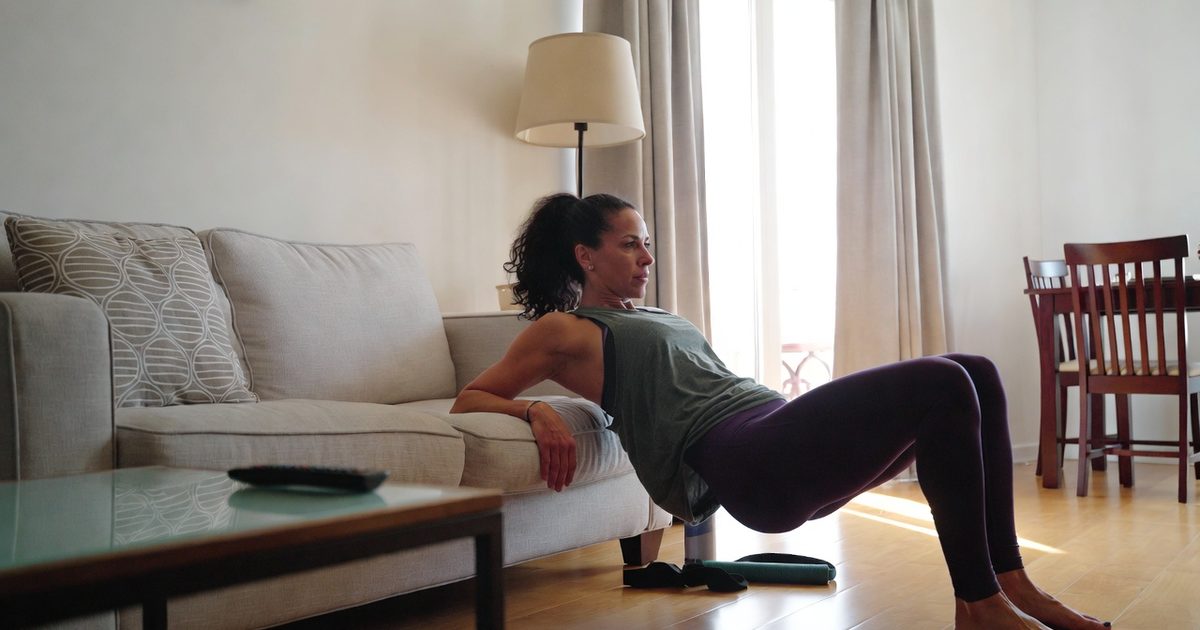
- Hip thrust: glutes and the back of the body. Rest your shoulder blades on the sofa and drive your hips up. A great exercise for glute shape.
Those four movements cover your whole body. When they stop being hard, add reps, slow the movement down, or buy a pair of dumbbells. Strength helps mobility and your back too. Train for strength and shape. Fat loss is mostly decided by food. Spot reduction does not work, which is why crunches do not burn belly fat.
A simple beginner plan, 2 to 3 times a week
You do not need a complicated plan from the internet. For a true beginner, a simple frame is enough: 2 to 3 sessions a week, one movement from each category in each session (squat, push, pull, hip thrust), and at least one rest day between sessions.
- Frequency: 2 to 3 full-body sessions a week. For a beginner, more is usually not better. Muscle grows while you rest.
- Volume: 2 to 3 sets of 8 to 12 reps for each exercise.
- Tempo: control the movement. Do not swing it. The last 1 to 2 reps should feel clearly hard.
- Rest: 60 to 120 seconds between sets, or by feel.
The most important principle in all of strength training is progressive overload: give the body a little more than last time. Add a rep, a set, a harder version of the exercise, or a kilogram more load. Without a gradual increase, the body has no reason to change. You do not have to add something every session. A trend upward over time is enough.
If you want the sessions written out, the workout plan is the place to start, and coaching is where I set the progression with you so you are not guessing for months.
Gym or home? Both work
You can build a great session at home or in a gym. What decides it is where you will actually show up. At home you have comfort and no commute to use as an excuse. In the gym you have more equipment, and progression is easier because you add weight in small jumps.
If you are starting, I would get it going at home with body weight and basic progression. Once it catches and you want to add load faster, a gym gives you more room to grow. It is not either-or. Combine them if you want.
And do not forget recovery. Strength grows when you sleep well and eat enough protein. Training is the signal. How much of it turns into strength and muscle depends a lot on your sleep and food.
How to pair strength with fat loss, or with shaping
Lifting and food are two separate levers. Lifting mostly shapes the body, and food decides what the scale does. If you want to lose fat, you need a modest calorie deficit. If you want to shape up and add a little muscle, you eat around maintenance, or slightly above it. The training stays similar either way.
You do not need miracle foods or crash diets for that. A flexible approach works: watch total intake and protein, not forbidden foods. The practical version is in flexible dieting.
If you want a number to start from, use the calorie calculator. The free Fat Loss Kit gives you a 7-day frame for what eating at those numbers can look like.
Frequently asked questions
Will I get bulky if I lift weights as a woman?
No. Women have far less testosterone than men, so they build a large amount of muscle slowly and with difficulty. Ordinary strength training, 2 to 3 times a week, tends to give you a firm, shaped body, not bulk.
How many times a week should a woman lift when she is starting?
For a start, 2 to 3 full-body sessions a week is plenty, with at least one rest day between them. For a beginner, more is usually not better, and rest days between sessions are part of the progress.
Can women do strength training at home with no equipment?
Yes. Body-weight work (squats, push-ups, hip thrusts, towel rows) is a complete start. A cheap resistance band helps with the pull. When it stops being hard, add reps, a harder version of the exercise, or a pair of dumbbells.
You might also like
- Will lifting make women bulky?
- Can you build muscle in a calorie deficit?
- Flexible dieting
- Strength training: one hour a week
Want me to coach you?
Gold coaching in English, fully written. A weekly report from your phone (3 minutes), my written answer with your plan, WhatsApp support Monday to Friday, calories and macros adjusted every week, a plan for eating out and travel. No video calls needed.
Apply for coaching Get the free Fat Loss Kit
Martin Barna
Online nutrition and fitness coach. Since 2013 I have coached 600+ clients.
Apply for coachingThis article is for information only. It is not medical advice. If you have a health condition, talk to your doctor.