
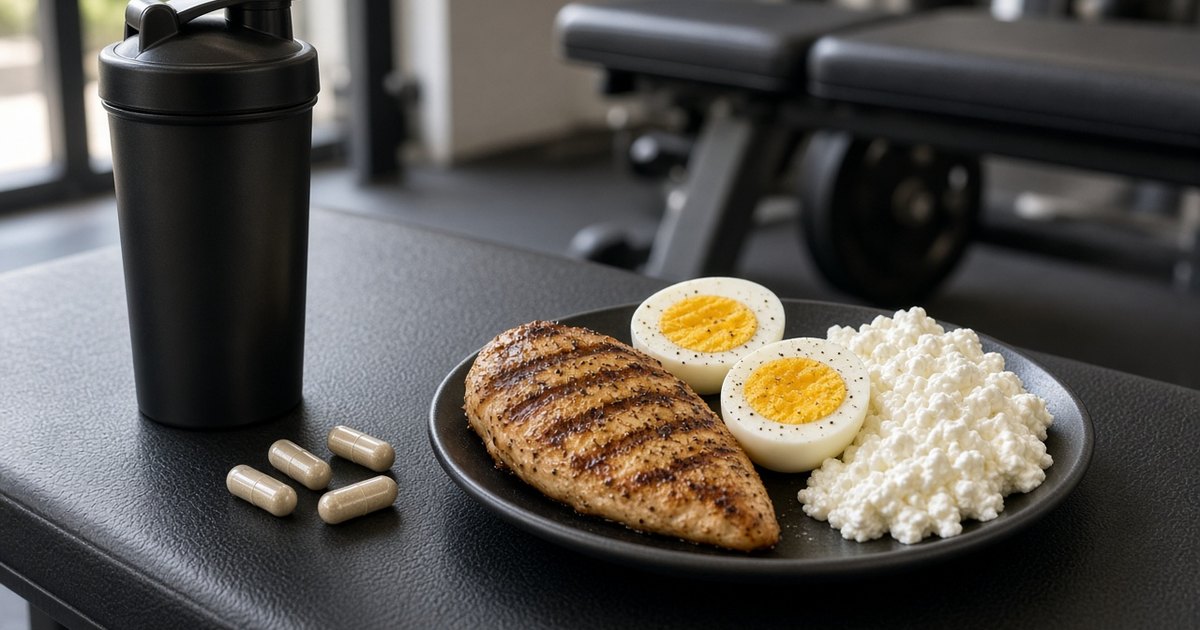
BCAAs are a sacred cow in the gym. The colorful powder in the shaker that supposedly keeps you from losing muscle and makes it grow faster. Fear sells it: "Skip BCAAs before training and your muscle will fall apart." It sounds responsible, like you are taking care of yourself. For anyone who eats enough protein, though, it is one of the supplements that gives you the least for your money.
If you eat normally, no. Every complete protein (meat, eggs, fish, dairy, whey protein) already has BCAAs, plus the remaining essential amino acids. What mainly takes muscle is a large, long calorie deficit, too little protein, and no strength training. Skipping a colored shake will not.
What BCAAs actually are
BCAA means "branched-chain amino acids," specifically three: leucine, isoleucine, and valine. They really are important amino acids for building muscle, leucine especially. That part is true. The catch is where you get them.
The body does not need only those three to build muscle. It needs the full spectrum of essential amino acids: nine kinds it cannot make and must get from food. Any complete protein (meat, eggs, fish, dairy, whey protein) already contains those three BCAAs. Plus the other six essential amino acids you also need. So when you eat a normal protein meal, you already have BCAAs. No powder required.
Why BCAAs alone are not enough for max growth
Second trap: someone thinks, "I will just take BCAAs alone, cheaper and more targeted." On their own, three amino acids give a much weaker muscle-building response than complete protein. Building muscle is like a wall: leucine gives the signal "build," but you need all the bricks: the full amino acid spectrum. With only a few, you have the signal and no material.
| What you take | What actually builds muscle |
|---|---|
| BCAA powder | Only 3 amino acids. Signals the muscle to "build," but not the full material. Expensive and incomplete. |
| Complete protein (meat, eggs, dairy, fish, protein powder) | All 9 essential amino acids including BCAAs. Signal and material together. Cheaper and more filling. |
That is why whole protein beats BCAA powder for almost everyone. More amino acids for less money, and it is real food. BCAAs are basically an expensive and incomplete way to get a piece of what is already in every chicken breast.
Where the "you will lose muscle" fear came from
BCAA marketing has ridden one note for years: fear. "Skip them and catabolism will eat your muscle." Smart, because fear sells better than logic. Reality is calmer.
Skipping a colored shake before training will not take your muscle. What takes muscle is mainly a large, long calorie deficit, too little protein in your diet, and no strength training that gives muscle a reason to stay. That trio decides it. BCAAs have no seat at that table. Cover those three and you keep most of your muscle, even if you never heard of BCAAs.
When they make sense, even in theory
I will be fair so this does not sound like a blanket "never." There is a narrow case where BCAAs are at least worth mentioning: training fasted on a very low protein intake. For example, someone who hits a hard morning session and overall barely eats protein. In that narrow case they could, in theory, help the muscle a bit during the session.
Even then the fix is simpler and cheaper: just eat more protein and have a normal meal or a scoop of protein powder before training. You solve the same problem better, you get the full amino acid spectrum, and you save money. That is an argument for fixing your protein.
Where to put the money instead
Supplements are not bad by themselves. Put them where they actually do something. If I ranked where your cash belongs, it would look like this:
- Enough protein from food. The foundation. Meat, eggs, dairy, fish, or whey protein when food alone is not enough. That is what builds muscle.
- Creatine. This one works and it is cheap. It helps performance and strength, it is well proven, and it costs pennies a day. If you want something for the shaker, buy this one. If you have kidney problems or take medication, ask your doctor before starting.
- Solid strength training. No powder replaces regularly giving muscle a reason to grow and stay.
- Sleep and recovery. Boring, I know. Muscle grows while you recover.
For a regular lifter who eats normally, BCAAs are mostly wasted money. They are not harmful. They just do not give you much, because you already have the same thing on your plate.
What to do in practice
No science lecture. Stick to the basics and ignore BCAAs:
- Aim for roughly 1.6-2.2 g of protein per kg (about 0.7-1.0 g per lb) of body weight per day. A sensible range for building and keeping muscle. Somewhere in the middle works for a lot of my clients. If you carry a lot of body fat, base it on your goal weight. If you have kidney disease, check your protein intake with your doctor first.
- Spread protein across the day. Not everything at dinner. Include protein in every main meal. It is easier to hit your total, and you stay fuller.
- If you hit that with food or protein powder, ignore BCAAs entirely. You already have them, plus the rest of the amino acids.
- Want to spend on a supplement? Put it into creatine and a quality protein powder, not BCAA powder.
So the next time someone pushes BCAAs as insurance against muscle loss, translate it: "I already get that in every protein meal, and more completely." Muscle stays with enough protein, strength training, and a sensible deficit. Keep the money in the basics. Those work. Be Effective!
Frequently asked questions
What are BCAAs?
BCAAs are branched-chain amino acids, specifically three: leucine, isoleucine, and valine. They matter for building muscle, leucine especially.
Why are BCAAs alone not enough for muscle?
On their own, three amino acids give a much weaker muscle-building response than complete protein. Leucine signals the muscle to build, but the material is missing: the body needs the full spectrum of essential amino acids, all nine.
When do BCAAs make sense, even in theory?
Only in a narrow case, in theory: training fasted on a very low protein intake. Even then, a normal meal or a scoop of protein powder before training is simpler and cheaper.
How much protein should I eat per day instead of BCAAs?
Aim for roughly 1.6-2.2 g of protein per kg (about 0.7-1.0 g per lb) of body weight per day. Somewhere in the middle works for a lot of my clients. If you carry a lot of body fat, base it on your goal weight. If you have kidney disease, check your protein intake with your doctor first. Spread protein across the day and include it in every main meal.
Which supplement should I spend on instead of BCAAs?
Creatine and a solid protein powder. Creatine works, it is cheap, it helps performance and strength, and it costs pennies a day. If you have kidney problems or take medication, ask your doctor before starting.
Related reading
- How Much Protein Per Day to Lose Fat? Simple Guide
- Build Muscle in a Calorie Deficit: Yes, It Can Work
- Fat Burners: What Works and What Is Wasted Money
- Calorie Deficit: How Much to Eat to Lose Fat
Want me to coach you?
Gold coaching in English, fully written. A weekly report from your phone (3 minutes), my written answer with your plan, WhatsApp support Monday to Friday, calories and macros adjusted every week, a plan for eating out and travel. No video calls needed.
Apply for coaching Get the free Fat Loss Kit Calculate your calories
Martin Barna
Online nutrition and fitness coach. Since 2013 I have coached 600+ clients through fat loss.
Apply for coachingThis article is for information only. It is not medical advice. If you have a health condition, talk to your doctor.