
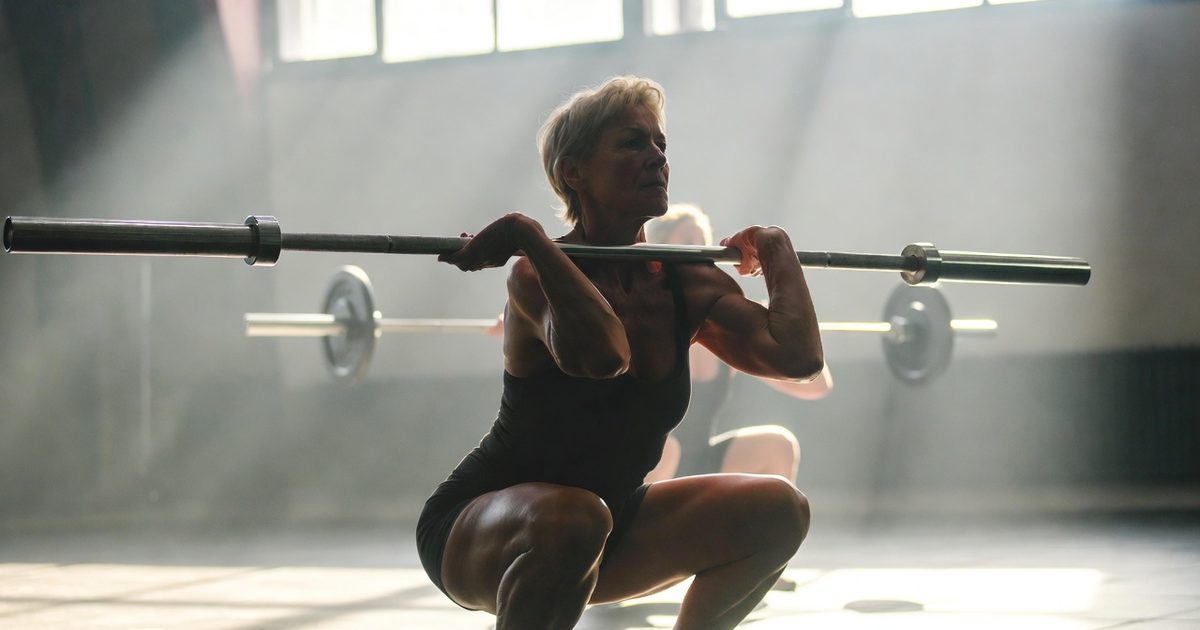
The unwritten rule is still around: if you want to be more flexible and more mobile, stretch. Lifting, people say, "shortens" muscle and turns you into a stiff brick. Look at what we know now, and it comes out the other way. Strength training taken through a full range of motion improves range of motion about as well as stretching does. On top of that, it builds strength and muscle.
Two words first: mobility and flexibility
Flexibility is the muscle's ability to be lengthened: how far you can get into an end position. Mobility is a step further: it is range of motion at a joint that you can also control and hold on purpose. In plain terms, you can get into a deep squat and also work there. Strength training trains exactly that: range where you also have strength and control.
What the studies show: strength raises range about like stretching
The research points the same way, with some caveats below. A large systematic review and meta-analysis from 2023 (Sports Medicine) pooled 55 studies and landed on a simple result: strength training increases range of motion by a moderate amount. That increase was not statistically different from what stretching alone can do. Adding stretching on top of strength training did not beat stretching alone either. In other words, for range of motion, lifting works about as well as stretching [1]. The effect was larger in untrained, sedentary people than in those already active [1].
A newer meta-analysis from 2025 (Journal of Strength and Conditioning Research) found a moderate effect of strength training on flexibility across 36 studies and nearly 1,500 people. The authors add a caveat: none of the studies had a low risk of bias and results varied a lot, so treat the size of the effect as an estimate [2]. One detail is worth keeping: more intense training had a bigger effect on flexibility. One proposed mechanism is the eccentric (lowering) phase, which may lengthen muscle fascicles (the bundles inside a muscle). The evidence on this mechanism is still limited.
Third, a head-to-head comparison. A small randomized trial from 2024 (BMC Sports Science, Medicine and Rehabilitation; 18 active adults, six per group) put people into three groups: strength training through a full range, static stretching, and a control group. By the end of the study, both training groups improved sit-and-reach flexibility by about the same amount (a standard forward-bend test). With only six people per group, take it as supporting evidence, not proof. The difference was what else they gained: the group that lifted also added strength on top of the flexibility. The lifting group gained more strength than the stretching group, measured at 50% and 95% of range of motion [3].
Why it works at all
When you load muscles through a full range of motion, you go to a deep squat, you lower the bar to where you feel a real stretch, and only then do you lift. You train the muscle in its lengthened position. Load at a long muscle length is what matters for mobility:
- The muscle learns to produce force at end range too. That is exactly what a muscle you have only stretched is missing. You can get there, but you cannot control it there.
- The eccentric (lowering) phase under load may lengthen muscle fascicles. This mechanism is still being studied, but the body does adapt to being strong while it is stretched.
- Your nervous system also gets used to the end position, so you tolerate more range over time (often called stretch tolerance).
The other side of that: if everything in the gym is a half rep (partial squats, presses you never finish, curls through a tiny arc), you never really load the muscles in a stretch. Then you can feel "stiff" even though you train. The cut-down range is what makes you feel stiff.
The point of the whole article: full range of motion
Not every kind of lifting improves mobility. Range matters, and so does load: the 2023 analysis found no significant gain from body-weight-only training, and the 2025 one found bigger effects with higher intensity. Half reps are unlikely to do much for your range. If you want mobility from your strength work, train like this:
- Squat to depth (as far as your hips and your technique allow), instead of stopping above parallel.
- Romanian deadlifts and deadlifts with a real hamstring stretch at the bottom.
- Lunges and Bulgarian split squats to full depth, which are useful for hip mobility.
- Presses and push-ups through a full range: chest all the way down, not a short tap and back up.
- Pull-ups and rows from a full hang: reach all the way at the bottom and open the shoulders.
One caveat from the 2023 meta-analysis: training with body weight only did not significantly improve range of motion. Push-ups and pull-ups are fine, but add load over time, or pair them with loaded presses and rows [1]. And on all of it, use a controlled eccentric: do not drop the weight. Brake it on purpose for 2-3 seconds. A slow, controlled lowering keeps the muscle under load while it is long, which is the part of the rep we are after.
| Full-range strength training | Static stretching | |
|---|---|---|
| Improves range of motion? | Yes, about as well as stretching. | Yes. |
| Adds strength? | Yes. | Little, if any, at typical doses. |
| Adds muscle? | Yes. | Little, if any, at typical doses. |
| Control at end range | Likely higher, because you build strength in that position (the 2024 trial measured strength at 95% of range). | Lower. You have range, not strength. |
| Time | Covers more than one job in the same session. | A separate session you have to add. |
Does that mean stretching is pointless?
No. Stretching has a place. If your range is genuinely limited somewhere, stretching after training or at another time can help open it, and a lot of people simply feel better when they do it. You do not have to add hours of stretching to be mobile. If you lift through a full range, you build mobility in the same session, along with strength and muscle. And if you have no time or no appetite for stretching, that is not a loss.
What to do with this
- Train through a full range of motion. Squats to depth, pulls with a stretch, presses all the way down. Range is what turns lifting into a mobility tool as well.
- Brake the eccentric. 2-3 controlled seconds on the way down keep the muscle loaded while it is long.
- Do not be afraid of a lengthened position under load, as long as the technique is sound and the weight is reasonable. For most healthy people it is well tolerated, and it is the position we want to train. If a lengthened position causes pain, back off and have it checked by a doctor or physical therapist.
- Add range gradually. You will go deeper over time, not by forcing it in the first session. Technique and progression still run the show.
- Keep stretching as an extra, not a duty. If it feels good, do it. Full-range lifting already covers most of what you need.
So the next time someone tells you that "weights only make you stiff," and that flexibility comes only from stretching, you already know how that holds up. Full-range strength training gives you range of motion comparable to stretching. It also gives you strength and muscle, which typical stretching routines add little of. Train the whole range, brake the eccentric, and let the muscles work while they are long. Be Effective!
Frequently asked questions
What is the difference between mobility and flexibility?
Flexibility is the muscle's ability to be lengthened: how far you can get into an end position. Mobility is range of motion at a joint that you can also control and hold on purpose.
Why does full-range lifting improve mobility?
You train the muscle in its lengthened position, so it learns to produce force at end range too. A slow, controlled lowering keeps the muscle under load while it is long, and your nervous system gets used to the end position, so you tolerate more range over time (often called stretch tolerance).
Which exercises should I use if I want lifting to improve mobility?
A squat to depth (as far as your hips and your technique allow), Romanian deadlifts and deadlifts with a real hamstring stretch, lunges and Bulgarian split squats to full depth, presses and push-ups through a full range, and pull-ups and rows from a full hang. On all of them, brake the weight on purpose for 2-3 seconds. Push-ups and pull-ups are fine, but add load over time, or pair them with loaded presses and rows, because body-weight-only training did not significantly improve range of motion in a 2023 meta-analysis.
Will lifting make me stiff?
You can feel stiff if everything in the gym is a half rep, such as partial squats, because you never really load the muscles in a stretch. The cut-down range is what does it.
So is stretching useless?
No. If your range is limited somewhere, stretching can help open it, and if your mobility is limited or you have a health problem, talk to a doctor or a physical therapist. You just do not have to add hours of stretching to be mobile if you lift through a full range.
Related reading
- Stretching before a workout does not prevent injury
- Sore muscles are not a sign of a better workout
- Sarcopenia: how not to lose muscle and strength after 50
Want me to coach you?
Gold coaching in English, fully written. A weekly report from your phone (3 minutes), my written answer with your plan, WhatsApp support Monday to Friday, calories and macros adjusted every week, a plan for eating out and travel. No video calls needed.
Apply for coaching Get the free Fat Loss Kit Calculate your caloriesSources, so you can check:
1) Alizadeh S, Daneshjoo A, Zahiri A, Hadjizadeh Anvar S, Goudini R, Hicks JP, Konrad A, Behm DG. Resistance Training Induces Improvements in Range of Motion: A Systematic Review and Meta-Analysis. Sports Medicine. 2023;53:707-722. https://doi.org/10.1007/s40279-022-01804-x
2) Favro F, Roma E, Gobbo S, Bullo V, Di Blasio A, Cugusi L, Bergamin M. The Influence of Resistance Training on Joint Flexibility in Healthy Adults: A Systematic Review, Meta-analysis, and Meta-regression. Journal of Strength and Conditioning Research. 2025;39(3):386-397. https://doi.org/10.1519/JSC.0000000000005000
3) Rosenfeldt MP, Stien N, Behm DG, Saeterbakken AH, Andersen V. Comparison of resistance training vs static stretching on flexibility and maximal strength in healthy physically active adults, a randomized controlled trial. BMC Sports Science, Medicine and Rehabilitation. 2024;16(1):142. https://doi.org/10.1186/s13102-024-00934-1

Martin Barna
Online nutrition and fitness coach. Since 2013 I have coached 600+ clients through fat loss, using what the research supports.
Apply for coachingThis article is for information only. It is not medical advice. If you have a health condition or your mobility is limited, talk to a doctor or a physical therapist.