
There is more marketing around cholesterol than around almost anything else. One week someone is selling you a "miracle" supplement for LDL. The next week you read that cholesterol does not matter at all. Food and exercise do move LDL, though not magically and not the same way in everyone. In some people, genes decide most of it, far more than whether they ate an egg.
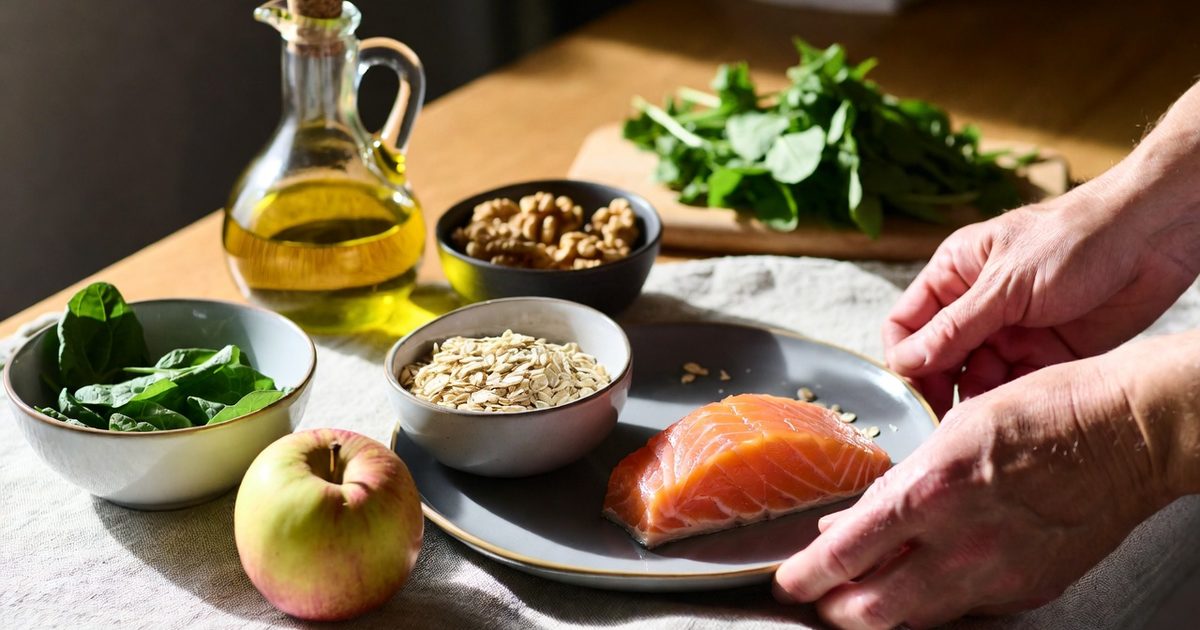
The strongest lever from food is to swap saturated fats (butter, fatty meat, lard) for unsaturated fats (olive oil and canola oil, nuts, seeds, avocado, oily fish). Soluble fiber helps, so does fat loss if you have weight to lose, and so does regular exercise. In the studies cited below, single changes moved LDL by roughly 10 to 18 mg/dL (about 0.25 to 0.45 mmol/L). Combined, lifestyle can do more, but it rarely matches effective medication.
A quick map first: what LDL is, and why we care
Cholesterol is not a poison. The body needs it. The problem is when LDL cholesterol (the "bad" fraction) stays high for a long time. Over time it takes part in clogging arteries and raises the risk of heart attack and stroke. That is why we want it reasonably low.
Important: cholesterol in food (in eggs, for example) is not the same thing as LDL in the blood. In most people, cholesterol from the diet moves the blood level only a little. What decides much more is the type of fat, fiber, body weight, and exercise. And genes. We will get there.
And a warning I mean seriously: this article is educational. I am not diagnosing you, and I am not telling anyone to change their medication. Take the numbers from your own blood to your doctor.
Fats: swapping saturated for unsaturated is the strongest food lever
This is about the best-supported thing in the food-and-LDL story. What matters most is which fat you eat. When you replace saturated fats (butter, fatty meat, lard, and a lot of palm fat in industrial sweets) with unsaturated fats (olive oil and canola, also called rapeseed oil, nuts, seeds, avocado, oily fish), LDL goes down.
A 2025 meta-analysis of controlled feeding trials in healthy adults (Advances in Nutrition) found that diets with a higher ratio of polyunsaturated to saturated fat lowered LDL by about 10 mg/dL (0.25 mmol/L) on average, and by around 16 mg/dL (0.4 mmol/L) when polyunsaturated fat actually replaced saturated fat. When saturated fat stayed the same, the effect was small and not significant. In other words, what counts is the swap: polyunsaturated fat taking the place of the saturated fat.
In practice: cook with oil instead of butter, a handful of nuts at a snack instead of a biscuit, oily fish twice a week, and cut back on processed meats and fried industrial food. Boring? Maybe. It works, and it is cheap, unlike most supplements.
Fiber: smaller effect, but it adds up
Soluble fiber (oats and oat bran, legumes, barley, apples, pears, psyllium) binds some bile acids and cholesterol in the gut and carries them out. The body then pulls cholesterol from the blood to restock the bile, and LDL falls. The drop is modest, but reliable, and it stacks with the other steps.
A bonus that often goes unsaid: food rich in fiber fills you up. Calories are easier to hold, and if you lose weight along the way, LDL goes down again (more on weight below). Fiber works on two fronts at once.
A target that makes sense: some legume or oats every day, vegetables with every main meal, fruit instead of a candy bar. If you cannot get there from food, psyllium is a cheap, tested backup. Start low, drink enough water, and if you take any medication, take psyllium a few hours apart from it and check with your doctor or pharmacist.
Fat loss and exercise: they help, so expect realistic numbers
If someone has extra weight, even modest fat loss improves the whole lipid profile: it mainly cuts triglycerides and raises the "good" HDL. The effect of weight loss on LDL itself is often smaller than people expect, and it depends a lot on what you replace the food with.
Watch one fashionable trap here. A large meta-analysis of 174 randomized trials from 2025, in The American Journal of Clinical Nutrition, confirmed that low-carb and keto diets do a nice job of lowering triglycerides and raising HDL, but LDL and total cholesterol rise slightly on them, most of all on keto. So "I lost weight on keto" does not automatically mean "my LDL is better." For some people it is the opposite. That is why, after any bigger change in how you eat, it is worth getting a follow-up blood test.
Exercise: regular training improves lipids. Its effect on LDL varies and shows up most where there is something to improve. A 2025 meta-analysis in the Brazilian Journal of Medical and Biological Research found that in postmenopausal women with obesity, 16 weeks of aerobic training and 12 weeks of strength training lowered LDL (by about 18 and 16 mg/dL, roughly 0.45 and 0.4 mmol/L) and raised HDL. That is one specific group, so do not read it as a promise for everyone. The message: exercise for your heart, your fitness, your head, and for keeping weight stable. Take a better LDL as a bonus, not as the main reason.
What is marketing, and what only a doctor can do for you
In the studies cited here, single changes moved LDL by roughly 10 to 18 mg/dL (about 0.25 to 0.45 mmol/L). Combined, lifestyle can do more. That is worth doing, but it rarely matches effective medication.
In familial hypercholesterolemia, an inherited disorder where LDL is high from birth, even the best diet is not enough on its own. The body is set up that way genetically. A doctor and treatment decide it here. How big is the gap in strength: a phase 3 trial published in JAMA, in people with the inherited form, showed that adding a newer drug (enlicitide, an oral PCSK9 inhibitor, 20 mg daily) lowered LDL by about 55 to 58% from baseline over one year, roughly 60% more than placebo. Patients were already on a statin, and most also on ezetimibe. You will not squeeze a number like that out of a salad.
And now a filter for marketing. Whenever you hear "clears your arteries," "miraculously lowers cholesterol in a week," or "replaces statins," that is a warning sign. Detox teas, garlic in a capsule on its own, megadoses of "natural" powders: either no effect, or a small one that is wildly oversold. The things with real support, even if it is modest, are boring: soluble fiber, plant sterols, omega-3s for triglycerides. None of them replaces treatment when you need it.
The most important sentence in this article: if you already take statins or other cholesterol drugs, do not stop them, and do not adjust the dose from an article on the internet, or from me. Your doctor handles that. Food and exercise are an excellent partner to treatment. They are not a replacement for it.
How to do it, without the fanaticism
If I take a few steps from all of this that actually move LDL, and that you can keep:
- Swap fats, do not just cut fats: oil instead of butter, nuts instead of a biscuit, fish instead of processed meat.
- Add fiber daily: oats, legumes, vegetables, fruit. If food will not get you there, psyllium, with enough water and a few hours apart from any medication.
- Deal with weight if there is extra: even a few kilos down improves triglycerides and HDL, and it supports LDL too.
- Move regularly: aerobic work and strength together. For the heart and the head. LDL as a bonus.
- After a bigger diet change, get a follow-up blood test: especially on low-carb and keto approaches, where LDL can go up.
- Leave drugs and target numbers to your doctor. Especially with an inherited pattern, or if treatment is already in place.
None of those steps is sexy, and none of them can be sold for a pile of money in one capsule. Together, done honestly and for the long haul, they do more than most of the "miracles" in the ads. And where the genes are too strong, that is what a doctor is for. Needing medication there is simply the right tool for that problem.
Frequently asked questions
Do eggs raise cholesterol in the blood?
Cholesterol in food, in eggs for example, is not the same thing as LDL in the blood. In most people, cholesterol from the diet moves the blood level only a little. The type of fat, fiber, body weight, exercise, and genes decide much more.
How much does swapping fats lower LDL?
A 2025 meta-analysis of controlled feeding trials: a diet with a higher share of polyunsaturated fat relative to saturated fat cut LDL by about 10 mg/dL (0.25 mmol/L) on average. Where polyunsaturated fat replaced saturated fat, it was around 16 mg/dL (0.4 mmol/L).
How does fiber help cholesterol?
Soluble fiber (oats and oat bran, legumes, barley, apples, pears, psyllium) binds some bile acids and cholesterol in the gut and carries them out. The body then takes cholesterol from the blood, and LDL falls. Modestly, but reliably.
Will a keto diet improve LDL?
Not automatically. A meta-analysis of 174 randomized trials from 2025 showed that low-carb and keto diets lower triglycerides and raise HDL, but LDL and total cholesterol rise slightly on them, most of all on keto. After a bigger diet change, a follow-up blood test is worth it.
Can I stop my statins because my diet is better?
No. If you take statins or other cholesterol drugs, do not stop them and do not adjust the dose from an article on the internet. Your doctor handles that. In inherited familial hypercholesterolemia, even the best diet is not enough on its own.
You might also like
If you want a calorie number to start from, use the calorie calculator.
Want me to coach you?
Gold coaching in English, fully written. A weekly report from your phone (3 minutes), my written answer with your plan, WhatsApp support Monday to Friday, calories and macros adjusted every week, a plan for eating out and travel. No video calls needed.
Apply for coaching Get the free Fat Loss KitSources, so you can check:
1) Hart TL, Damani JJ, DiMattia ZS, Tate KE, Jafari F, Petersen KS (2025). Dietary Polyunsaturated to Saturated Fatty Acid Ratio as an Indicator for LDL Cholesterol Response: A Systematic Review and Meta-Analysis of Randomized Clinical Trials. Advances in Nutrition, 16(10):100502. DOI: 10.1016/j.advnut.2025.100502
2) Feng S, Liu R, Thompson C, et al. (2025). Effects of carbohydrate-restricted diets and macronutrient replacements on cardiovascular health and body composition in adults: a meta-analysis of randomized trials. The American Journal of Clinical Nutrition, 122(5):1461-1478. DOI: 10.1016/j.ajcnut.2025.09.012
3) Bernal JVM, Sanchez-Delgado JC, Jacome-Hortua AM, et al. (2025). Effects of physical exercise on the lipid profile of perimenopausal and postmenopausal women: a systematic review and meta-analysis. Brazilian Journal of Medical and Biological Research, 58:e14194. DOI: 10.1590/1414-431X2025e14194
4) Ballantyne CM, Gellis L, Tardif JC, et al. (2026). Efficacy and Safety of Oral PCSK9 Inhibitor Enlicitide in Adults With Heterozygous Familial Hypercholesterolemia: A Randomized Clinical Trial. JAMA, 335(2):129-139. DOI: 10.1001/jama.2025.20620

Martin Barna
Online nutrition and fitness coach since 2013, 600+ clients coached. Evidence-based nutrition and training.
Apply for coachingThis article is for information and education only. It is not medical advice and it is not a diagnosis. Take your cholesterol numbers, and any medication (statins especially), to your doctor. Do not change treatment on your own.