
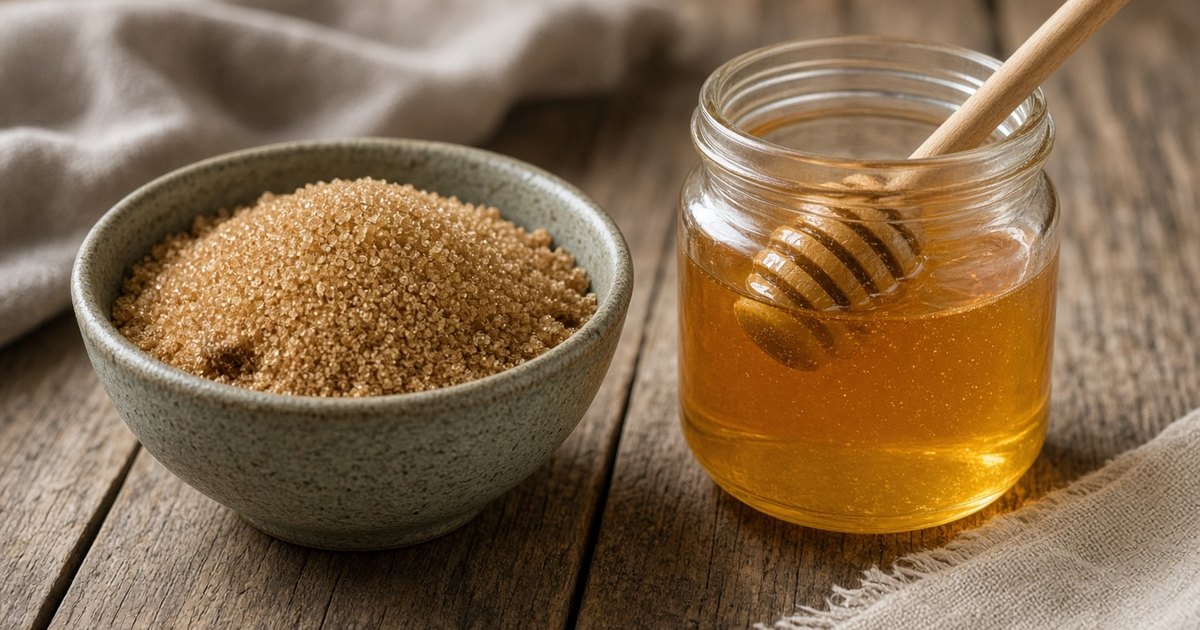
White sugar is the villain, and honey, brown sugar, agave, or coconut sugar are the "healthier" choice. That idea has stuck for years, and people pay a premium for it on the shelf. It sounds nice: swap refined sugar for something "natural" and suddenly it counts as healthier, and fat loss gets easier. Dig into it, though, and it is still mostly sugar. The "natural" label does not decide your body composition or your health.
In practice, no. Honey, brown sugar, coconut sugar, agave, and maple syrup are overwhelmingly sugars, which means extra calories. Brown sugar is mostly white sugar with molasses, and honey is calorie-comparable to sugar. What shapes your body is your total calorie intake, and sugar is part of it. The form of sweetener is secondary.
"Natural" still mostly means sugar
Honey, brown sugar, coconut sugar, agave, and maple syrup are all mostly sugar. Add them to food and you add energy, just like with white sugar.
The word "natural" does a psychological trick here. It sounds like a license: "it is natural, so I can have more," or "it is natural, so it does not hurt." Neither is true. Natural does not mean you will lose fat from it. And it does not mean it is healthy with no limit. Sugar from a flower or a beehive is still extra energy in the body that you have to account for.
Brown sugar = white sugar with a drop of molasses
This might be the funniest part. Brown sugar is mostly white sugar with added (or not fully removed) molasses. That gives it color, moisture, and that light caramel taste. That is the whole story.
Yes, molasses has a pinch of minerals: a little iron, calcium, potassium. But there is so little of it that to get anything meaningful from those traces, you would have to eat pounds of brown sugar. By then, the extra sugar and calories are a far bigger problem than any minerals you gained. Taking brown sugar "for the minerals" is like eating a doughnut for the fiber in the sprinkles. The difference versus white sugar is negligible in practice.
Honey and agave: not a "diet" sweetener
Honey has a great image: cold season, tea, grandma's pantry. Calorie-wise, though, it is comparable to sugar. It has a bit of extra nutrients and flavor versus refined sugar, but that does not make it a "diet" sweetener. A spoon of honey is still a spoon of sugar with calories.
Agave is similar, just from another angle. It often gets praised for a "low glycemic index," but that is because it is mostly fructose. A low glycemic score does not help you if you eat too much sugar overall. And watch one trap with both: they are liquid. Liquid calories are easy to miss. They do not fill you up like solid food, and you can pour more into yogurt, coffee, or over oatmeal than you realize. None of these options is a diet shortcut.
What actually decides: the total, not the form
Whether you lose or gain fat comes down to your total calorie intake, sugar included. Your body mostly does not care whether that sugar came from a white bag, a jar of honey, or a bottle of agave. What it tracks is how much arrives altogether.
Swapping a teaspoon of sugar for a teaspoon of honey will not save you or ruin you. If anything, a spoon of honey has slightly more calories than a spoon of sugar, because honey is denser. It is a small detail in your overall diet. If you tell yourself you swapped sugar for honey and "fixed it," while you still eat the same amount of sugar or more, you have not moved. What counts is the amount and your diet as a whole.
| Sweetener | Mostly what | Reality in practice |
|---|---|---|
| White sugar | Sucrose | The reference "villain," but just sugar and calories, nothing more, nothing less. |
| Brown sugar | Sucrose + molasses | White sugar with a drop of molasses. Minerals in negligible traces. Calories almost the same. |
| Honey | Glucose + fructose | Slightly fewer calories per gram (it contains water), slightly more per spoon. Not a "diet" option. |
| Agave | Mostly fructose | Low glycemic score, but still sugar and calories. Liquid = easy to overdo. |
| Coconut / maple | Sucrose / sugars | "Natural" label, but calories practically like sugar. |
Where "natural" sweeteners do make sense
Do not take this as "throw out the honey." Not at all. "Natural" sweeteners have a place, just for a different reason than the myth claims:
- Taste and meal context. A spoon of honey in yogurt, maple syrup on pancakes, coconut sugar in coffee. It tastes good and fits the food. That is completely fine and a legitimate reason. You are using it for taste, not for "health."
- Glycemic differences tend to be modest in a real meal. When you eat sugar as part of a meal with protein and fat, the differences in blood sugar response between honey, sugar, and maple syrup tend to be modest. Do not build a fat-loss strategy on that. If you have diabetes or prediabetes, talk to your doctor or dietitian about which sweeteners fit your plan.
- None of them is "free." The moment you treat that as a reason to have more, the myth wins again. Honey for taste, yes, but count it as sugar.
What to do with this
In practice, it looks like this:
- Watch total sugars and calories, not whether the package says "organic" or "natural." That is the question that actually decides body composition.
- Honey for taste is fine, but count it as sugar. A spoon in oatmeal? Fine, just include it in the day like any other sugar.
- Do not swap sugar for "healthier" sugar hoping that fixes anything. What fixes it is eating less of it.
- For many people, drinks are the biggest source of sugar. Sweetened sodas, juices, sweetened coffees, energy drinks: that is where a lot of sugar comes in without you noticing. Cut there before you worry about white versus brown sugar in your tea.
So next time someone says they switched from sugar to honey or agave and "now they eat healthy," translate that to "I still eat sugar, just in another form." Whether you lose fat comes down to your total intake, a calorie deficit, and whether you can keep it up. Pick what you like and count it honestly. Be Effective!
Frequently asked questions
Does brown sugar have more minerals?
Molasses has a pinch of iron, calcium, and potassium, but so little that you would have to eat pounds of brown sugar to get anything meaningful from it. The difference versus white sugar is negligible in practice.
Is agave syrup good for fat loss?
It is not a diet shortcut. Its low glycemic index comes from being mostly fructose, and that does not help you if you eat too much sugar overall. It is also liquid, so it is easy to overdo.
Can I still use honey?
Sure, for the taste. A spoon of honey in oatmeal is fine. Just count it toward your day like any other sugar. One exception: never give honey to babies under 12 months, because of the risk of infant botulism.
Where should I cut sugar first?
Drinks. For many people, sweetened sodas, juices, sweetened coffees, and energy drinks are the biggest sugar source. Cutting there pays off before you worry about white versus brown sugar in your tea.
Related reading
- Is sugar poison? The myth about sugar, fat gain, and diabetes
- The calorie deficit, in short
- Flexible dieting: how to eat what you like and still lose fat
Want me to coach you?
Gold coaching in English, fully written. A weekly report from your phone (3 minutes), my written answer with your plan, WhatsApp support Monday to Friday, calories and macros adjusted every week, a plan for eating out and travel. No video calls needed.
Apply for coaching Get the free Fat Loss Kit Calculate your calories
Martin Barna
Online nutrition and fitness coach. Since 2013 I have coached 600+ clients. I base my coaching on research and on what I see in practice.
Apply for coachingThis article is for information only. It is not medical advice. If you have a health condition, talk to your doctor.